
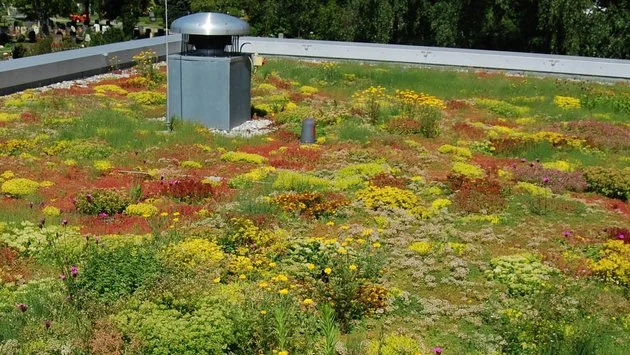
A compact technical solution with a major role in green roof performance
The success of a green roof, a planted planter, or a low-profile vegetation system does not depend only on plant selection or substrate depth. In reality, the long-term performance of such systems is based on one of the most critical technical factors: proper water management within the build-up.
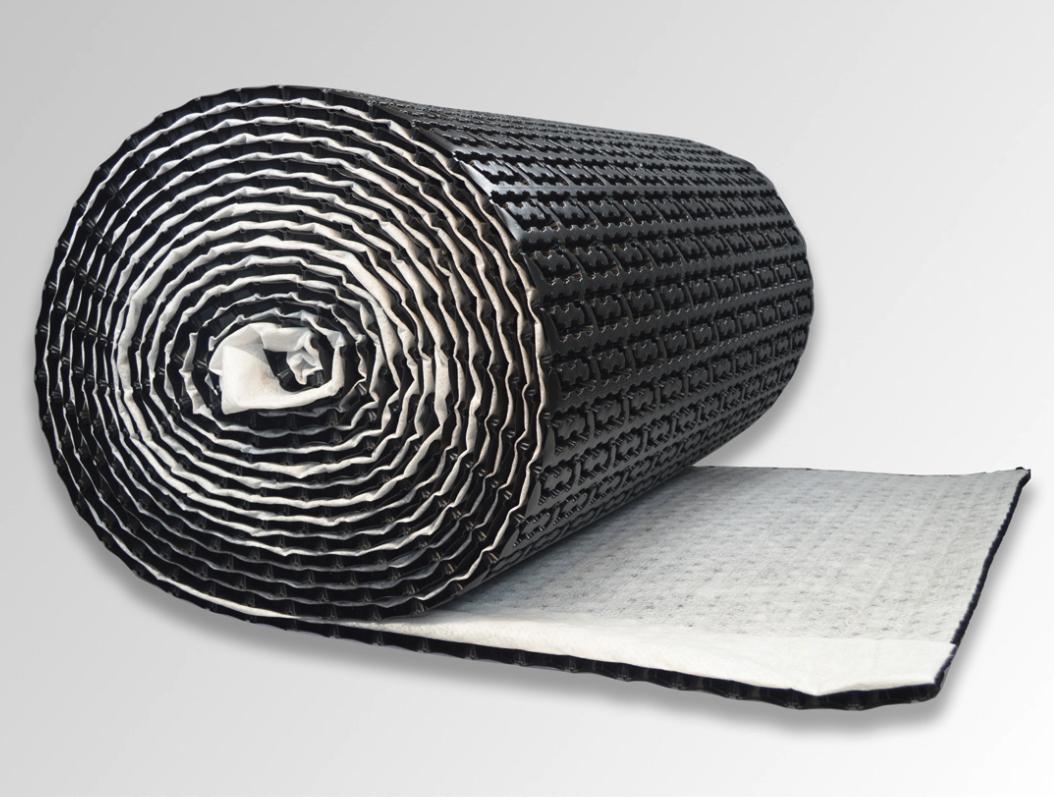
OptiGreen FKD20R is a practical and efficient drainage solution for applications where drainage, temporary water retention and filtration are required within a compact system build-up. It is a drainage element supplied in roll form, with an integrated filter fleece on its upper side. This filter fleece separates the growing medium from the drainage layer, allowing water to pass through while preventing fine substrate particles from entering and blocking the drainage structure.
In simple terms, OptiGreen FKD20R is not just a simple plastic drainage sheet. It is a multifunctional technical layer designed to create a controlled drainage space beneath the growing medium, remove excess water, and at the same time retain a limited amount of water that can support the vegetation.
This combination of drainage and water retention makes OptiGreen FKD20R particularly suitable for planted planters, raised beds, small green roof areas, low-profile extensive green roofs, sedum roofs and lightweight planting applications where a technically correct but cost-effective solution is required.
What is OptiGreen FKD20R?
OptiGreen FKD20R is a drainage and water-retention element in roll form. It consists of a profiled drainage layer with an integrated filter fleece attached to the upper surface. The profiled structure creates voids for water movement, while the filter fleece prevents the migration of fine particles from the growing medium into the drainage cavities.
The integration of the filter fleece is one of the key advantages of the product. In a conventional build-up, the installer would normally have to place the drainage element first and then apply a separate filter fleece above it, paying attention to overlaps, joints, cuts and correct positioning. With OptiGreen FKD20R, these two functions are combined in a single product, reducing installation time and limiting the risk of errors during application.
The operating principle is simple but technically important: water passes through the growing medium, is filtered through the integrated fleece, enters the drainage layer, part of it is temporarily retained within the cavities, and the excess water is directed towards the drainage outlets.
In this way, the system helps prevent prolonged waterlogging of the growing medium, while also avoiding the immediate loss of all available water after rainfall or irrigation.
Why drainage is critical in planters and low-profile green roofs
In every planted construction, water must be managed in balance. Plants need moisture, but roots also need oxygen. When the growing medium remains permanently saturated, oxygen levels around the root zone are reduced. This can lead to root stress, poor plant development, fungal problems and gradual degradation of the planting system.
On the other hand, when a build-up drains too quickly without any temporary water retention, the growing medium can dry out rapidly, especially during hot and dry periods. This is particularly important in Mediterranean climates, where long dry summers and high temperatures place additional stress on plants.
OptiGreen FKD20R helps balance these two requirements. It creates a drainage space beneath the growing medium so that excess water can be removed, while still retaining a limited quantity of water within the system. For low-profile planting, sedum, aromatic plants, herbaceous vegetation and lightweight planter applications, this balance is extremely important.
The technical function of OptiGreen FKD20R within the build-up
The function of OptiGreen FKD20R can be divided into four main technical roles.
- Filtration
The integrated filter fleece allows water to pass from the growing medium into the drainage layer, while preventing fine particles from migrating downward. This is essential because, without a proper filtration layer, fine substrate particles can enter the drainage cavities, reduce the water flow capacity and gradually compromise the performance of the system.
- Drainage of excess water
The profiled structure of OptiGreen FKD20R creates a continuous drainage space below the growing medium. Through this space, excess water can move horizontally towards the drainage outlets.
This is particularly important in long planters, small roof areas with limited slopes, or applications where water outlets are not located directly below every planted area.
- Temporary water retention
The cavities within the drainage element retain a certain amount of water. This should not be understood as a full irrigation reservoir, but rather as a limited water reserve that helps maintain a more stable moisture balance in the root zone.
This can contribute to better plant performance, especially in shallow systems where the growing medium volume is limited.
- Improved aeration at the base of the growing medium
By creating a void beneath the growing medium, OptiGreen FKD20R also contributes to improved air movement at the base of the planting layer. This supports healthier root development, reduces the risk of anaerobic conditions and improves the long-term stability of the planting system.
A practical alternative to more complex and costly build-ups
In many small-scale applications, such as planted planters, raised beds, low-profile roof gardens or small non-accessible green roofs, the build-up is often either too basic or unnecessarily complex.
In the first case, simple solutions such as loose gravel, generic geotextiles or improvised drainage layers are often used. Although these may appear economical at first, they can create problems over time: excessive weight, poor water management, clogging, insufficient filtration, and uneven moisture distribution.
In the second case, complex multi-layer systems may be specified, including separate drainage boards, separate filter fleeces, additional water-retention layers and thicker build-ups. These systems are necessary for larger or more demanding green roofs, intensive planting areas or projects with higher mechanical and hydraulic requirements. However, for small planters and low-profile planting areas, they may increase cost and complexity without always being necessary.
OptiGreen FKD20R sits between these two approaches. It provides a technically reliable, lightweight and easy-to-install solution without adding unnecessary complexity. This makes it ideal for projects where the objective is to achieve proper drainage, reasonable water retention, fast installation and controlled cost.
Ideal applications for OptiGreen FKD20R
OptiGreen FKD20R is particularly suitable for applications where low build-up height, quick installation and reliable drainage are required.
Planted planters
Planters are one of the most suitable applications for OptiGreen FKD20R. In large linear planters, metal planters, custom-built planters or raised planting beds, the roll can be installed quickly at the base, cut to the required dimensions and used as a continuous drainage layer beneath the growing medium.
In such applications, OptiGreen FKD20R helps prevent water from stagnating at the bottom of the planter while supporting a more balanced moisture environment for the plants.
This is especially useful in shallow planters, where every centimetre of build-up height is important.
Non-accessible low-profile green roofs
In extensive green roof systems where regular pedestrian use is not required and access is limited mainly to maintenance, OptiGreen FKD20R can operate as a practical drainage layer beneath the growing medium.
It is suitable for sedum systems, aromatic plants, low herbaceous vegetation and Mediterranean drought-tolerant planting schemes.
Small garden roofs and private residential applications
In private residences, terraces, pergolas, shelters, small roofs or architectural planting zones, OptiGreen FKD20R offers a clean and efficient technical solution.
It can be used where the aim is to improve aesthetics, enhance microclimate performance, create green surfaces and reduce thermal stress, without requiring a heavy or highly complex intensive green roof system.
Raised beds on roofs, terraces or balconies
In constructed planting beds placed over hard surfaces, OptiGreen FKD20R can function as the main drainage layer, provided that waterproofing, slopes and drainage outlets have been properly designed.
Its roll format and easy cutting make it practical for applications with corners, narrow widths, irregular geometries or confined installation areas.
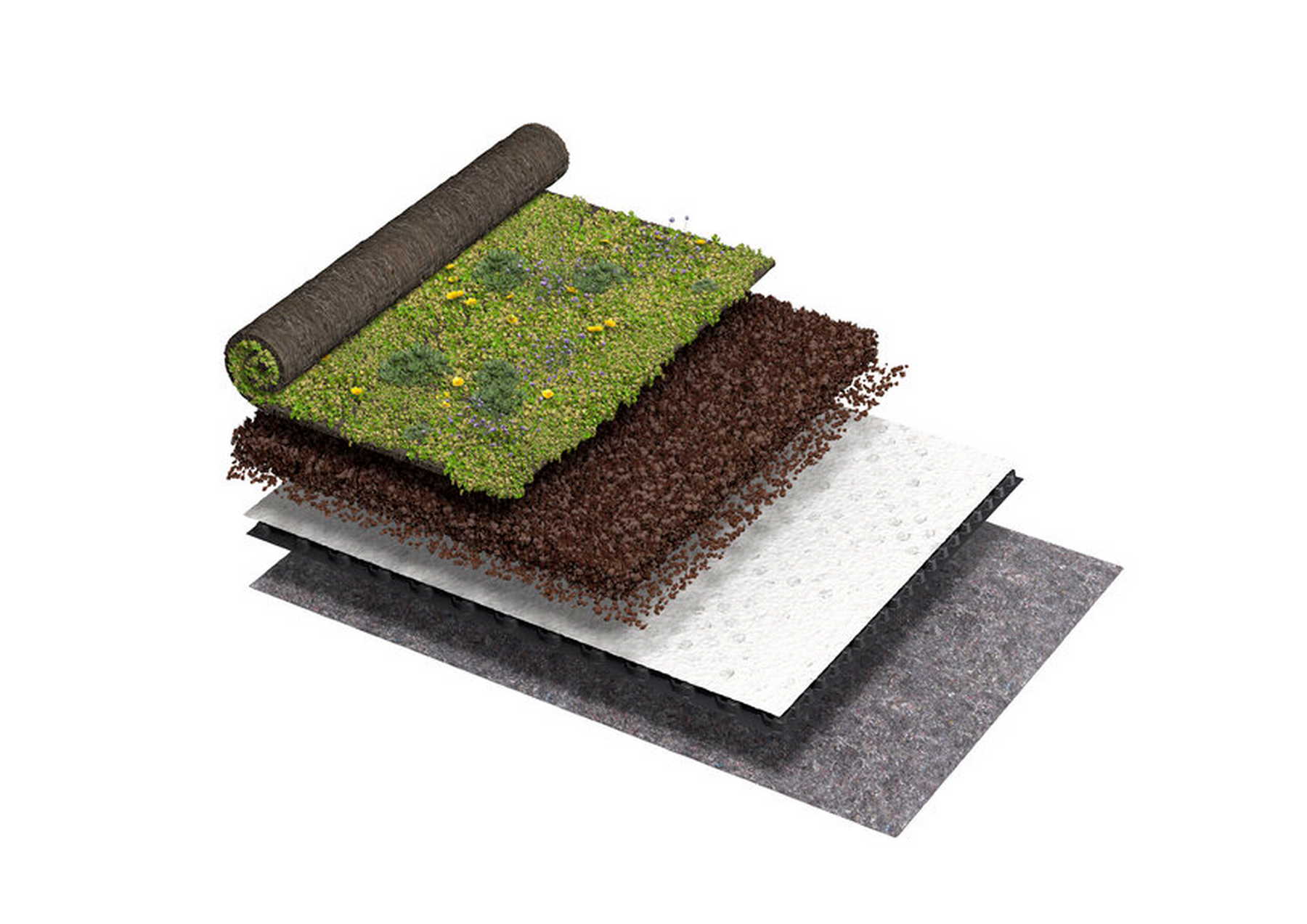
Indicative build-up for planted planters
A typical technical build-up using OptiGreen FKD20R in a planted planter may include:
- Planter structure or planting container
- Waterproofing layer, where required
- Root barrier, if the waterproofing is not certified as root-resistant
- Protection fleece at the base and vertical sides
- OptiGreen FKD20R as drainage and water-retention layer
- Suitable lightweight growing medium
- Planting according to depth, orientation and irrigation requirements
- Irrigation system, where required
The correct function of the planter does not depend only on OptiGreen FKD20R, but on the entire technical design. There must be a clear route for excess water to escape, the waterproofing must be protected, and the growing medium must be suitable for planter or green roof applications.
Ordinary garden soil should not be used, as it can compact, clog the filter layer and reduce drainage performance.
Indicative build-up for a low-profile non-accessible green roof
In a small, non-accessible low-profile green roof, an indicative build-up may include:
- Structural roof slab
- Falls and waterproofing
- Root barrier, where required
- Protection fleece
- OptiGreen FKD20R as drainage and water-retention element
- Extensive green roof growing medium
- Low-maintenance vegetation
- Gravel strips around outlets, upstands and technical elements
- Access provision for maintenance and inspection
In these applications, it is important to clarify that OptiGreen FKD20R does not convert the roof into a pedestrian-accessible surface. If the project requires regular foot traffic, paving, walkways, technical equipment support or higher mechanical loading, a different build-up must be designed with appropriate drainage, protection and load-distribution layers.
Main advantages of OptiGreen FKD20R
- Fast and easy installation
The roll format allows the product to be quickly unrolled and positioned on site. It can be cut easily, adapted to planter shapes, corners and small surfaces, and installed without complex tools or machinery.
This reduces labour time and simplifies the installation process.
- Integrated filter fleece
The integrated filter fleece reduces the need for a separate filtration layer. This limits the risk of incorrect overlaps, open joints or displacement of the fleece during the placement of the growing medium.
- Drainage and water retention in one product
OptiGreen FKD20R removes excess water while retaining a limited quantity within the drainage structure. This is particularly valuable in Mediterranean conditions, where intense rainfall events may be followed by long dry periods.
- Low build-up height
With a compact profile, OptiGreen FKD20R can be integrated into projects where available height is limited. This is especially useful in planters, terraces, small roofs and existing structures where the overall build-up must remain as low as possible.
- Lightweight solution
The low weight of the material makes it suitable for applications where permanent loads must be controlled. This does not eliminate the need for structural assessment, but it is a clear advantage compared with heavy loose aggregate drainage layers.
- Cleaner site application
Compared with gravel, pumice or other loose drainage aggregates, OptiGreen FKD20R offers a cleaner and more controlled installation. This is important in residential projects, hotels, terraces, roofs with difficult access and projects where installation time must be reduced.
- Reduced risk of installation errors
Because OptiGreen FKD20R combines drainage and filtration in one product, the number of separate installation steps is reduced. Fewer layers mean fewer potential mistakes during application.
Comparison with other drainage solutions
OptiGreen FKD20R compared with gravel
Gravel has traditionally been used as a drainage layer. Although it can provide drainage, it also has important disadvantages. It increases the weight of the construction, requires greater thickness, is more difficult to transport and install, and does not offer the same controlled water-retention function.
OptiGreen FKD20R provides a lighter, thinner and more consistent technical solution, especially for planters and small green roof areas.
OptiGreen FKD20R compared with a simple geotextile
A geotextile alone is not a drainage layer. It acts mainly as a filter or separation layer. If only a geotextile is placed below the growing medium, there is no proper drainage void for water movement.
OptiGreen FKD20R, on the other hand, combines a drainage structure with an integrated filter fleece.
OptiGreen FKD20R compared with more complex drainage systems
In larger or more demanding green roof systems, higher drainage elements or systems with greater compressive strength and water storage capacity may be required.
However, for low-profile planting, planters and small non-accessible roofs, OptiGreen FKD20R can provide a simpler, faster and more cost-effective solution.
Key design considerations
Although OptiGreen FKD20R is easy to install, proper technical design remains essential.
First, the waterproofing must be checked. In planted structures, the waterproofing layer must either be root-resistant or protected with a suitable root barrier. A drainage layer does not replace root protection.
Second, drainage outlets must be correctly designed and maintained. OptiGreen FKD20R can direct water towards the outlets, but if the outlets are blocked, insufficient or incorrectly positioned, the system will not function properly.
Third, the growing medium must be suitable. Ordinary garden soil can compact, become muddy, block the filter fleece and reduce drainage performance. A structurally stable green roof or planter substrate should be used.
Fourth, plant selection must match the available growing depth, exposure, irrigation regime and project conditions. OptiGreen FKD20R supports low and lightweight planting systems, but it does not eliminate the biological requirements of the plants.
Suitable planting types
OptiGreen FKD20R is particularly suitable for low to medium-height planting, depending on the available substrate depth. Indicative planting types include:
- Sedum and low-maintenance succulents
- Mediterranean aromatic plants
- Low herbaceous vegetation
- Drought-tolerant planting schemes
- Small shrubs in planters with sufficient depth
- Lightweight planting compositions for private roofs and terraces
Plant selection should always consider substrate depth, orientation, wind exposure, irrigation frequency and the structural capacity of the construction.
Application in Mediterranean climates
In Mediterranean climates, planted systems face two main challenges: intense rainfall events during the wet season and prolonged dry periods during the summer.
This means that a planting system must be able to remove excess water quickly during heavy rainfall, while also maintaining the best possible moisture balance during hot and dry periods.
OptiGreen FKD20R responds well to this logic. It combines drainage with limited water retention, supporting better moisture management within the build-up.
It does not replace irrigation in Mediterranean conditions, but it helps the system make better use of rainfall and irrigation water.
This is especially important in planters and small green roofs, where the volume of growing medium is limited and drying can occur quickly.
Maintenance and inspection
OptiGreen FKD20R is a passive technical element and does not require direct maintenance as a product. However, the overall planted system should be inspected periodically.
In green roofs, drainage outlets, gravel strips, overflow points and areas around technical installations should be checked regularly.
In planters, outlet holes must remain clear, and there should be no permanent standing water at the base.
Plant maintenance is also important: irrigation control, removal of unwanted vegetation, substrate top-up where required and regular inspection of plant health.
Common installation mistakes
One common mistake is installing a drainage element without providing a proper drainage route. OptiGreen FKD20R cannot function correctly if excess water has nowhere to go.
A second mistake is using ordinary garden soil instead of a suitable growing medium. Garden soil can compact, clog the filter fleece and reduce both aeration and drainage.
A third mistake is omitting root protection where the waterproofing is not root-resistant. The drainage layer does not protect the waterproofing from root penetration.
A fourth mistake is using the product in applications for which it has not been designed, such as pedestrian-accessible surfaces, traffic areas or zones with increased mechanical loads, without a specific technical build-up.
Why Ecoverti recommends OptiGreen FKD20R
Ecoverti recommends OptiGreen FKD20R for applications where a practical, technically correct and cost-balanced solution is required for planted planters and low-profile green roofs.
The product covers the basic needs of a lightweight planted system: drainage, filtration, protection against clogging and limited water retention.
Compared with improvised solutions, it offers a significantly better technical function. Compared with more complex build-ups, it offers easier installation, fewer separate materials and faster application.
This makes OptiGreen FKD20R particularly useful in projects where the goal is to achieve a reliable result without unnecessary complexity.
Ecoverti’s approach is not to recommend the heaviest or most expensive system by default, but the correct system for each application. In large intensive green roofs, pedestrian-accessible garden roofs or projects with high structural and hydraulic requirements, a different system may be necessary. However, in planters, small extensive green roofs and low-profile planted areas, OptiGreen FKD20R can be an excellent technical and commercial solution.
Conclusion
OptiGreen FKD20R is a technical product that simplifies the build-up of planted planters and low-profile green roofs without compromising the essential functions required in a properly designed planting system.
With its integrated filter fleece, drainage structure, water-retention capacity and easy roll-form installation, it offers a complete solution for low-height, lightweight and cost-sensitive applications.
For projects where technical reliability, fast installation and reasonable cost must be combined, OptiGreen FKD20R is an ideal alternative to more complex, heavier or more difficult drainage systems.
Especially in planted planters and non-accessible low-profile green roofs, it provides exactly what the construction needs: proper drainage, controlled moisture balance and a stable base for healthy plant development.