
Benefits, Legislation and Modern Technology
In recent years, green roofs—also referred to as planted roofs, roof gardens, or vegetated roofs—have moved beyond the category of “special architectural features” and into a much more important one: green infrastructure for buildings and cities. In Greece, where urban heat stress is strong, summer temperatures are demanding, and the lack of quality green space is increasingly visible, a green roof is not simply an aesthetic decision. It is a solution linked to energy performance, stormwater management, microclimate improvement and the long-term enhancement of real estate value. Greek legislation already provides a framework for planted roof surfaces, and both Greek and international research support their environmental and technical value.
For ECOVERTI, however, the discussion goes further than listing generic advantages. The real question is what a properly designed green roof means in practice. It means the correct build-up, the correct system selection, technically appropriate growing media, compatibility with the building, a rational irrigation strategy and planting adapted to the project’s actual microclimate. It also means connecting the study phase with the construction phase and, later, with long-term performance. This is why ECOVERTI presents green roofs not merely as a service but as a technical field supported by specialised systems, real projects and materials such as ERSM – Ecoverti Roof Substrate Mix, alongside system solutions already presented on ecoverti.com.
What is a green roof from a technical point of view?
A green roof is not “soil and plants on a flat roof.” It is a multi-layer technical system installed above the waterproofing of a building, and each layer has a specific function. In its basic form, the system includes waterproofing protection, root-resistant protection where required, a drainage layer, a filter layer, a technical growing medium and the selected vegetation. European practice and the FLL-based technical approach treat the green roof precisely in this way: as a coordinated system in which every layer affects the long-term performance of the whole.
In practice, this means that two green roofs may look similar in their first year and behave very differently by year three or year five. The difference usually lies in the drainage concept, the quality of the system layers, the substrate and the overall technical quality of the execution. This is why ECOVERTI places strong emphasis on correct system selection, correct drainage, waterproofing protection and suitable growing media, including ERSM – Ecoverti Roof Substrate Mix as part of its technical logic for roof garden applications.
Extensive, semi-intensive or intensive green roof?
The distinction between extensive, semi-intensive and intensive green roofs is fundamental because it defines depth, weight, cost, maintenance and final use of the space. Extensive systems usually have shallower growing media, lower structural loads and more resilient low vegetation. Semi-intensive systems occupy the middle ground. Intensive systems—what most people think of as a true roof garden—allow for deeper substrates, larger plants, shrubs, lawns, even ponds and high-use outdoor areas. The technical literature and applied market practice treat this distinction as one of the core decisions in green roof design.
This differentiation is also visible in the system logic already presented by ECOVERTI. Rather than presenting one generic “green roof solution,” the company shows a range of system families such as Lightweight Roof, Economy Roof, Nature Roof, Garden Roof and water-management-oriented systems. The point is not simply whether a planted roof will be built, but which system is appropriate for a specific building, a specific use and a specific climate context.
Why are green roofs especially important in Greece?
The Greek context makes green roofs especially relevant. Athens and other urban centres face intense heat island conditions, limited urban greenery and significant summer heat loads on buildings. Research focused on Athens has shown that green roofs can play an important role as a nature-based solution under heatwave conditions, while measured case studies in Greek buildings have demonstrated tangible improvements in thermal performance and building energy behaviour.
In measured applications in Athens, medium-scale and large-scale green roof systems have shown strong differences in surface temperature behaviour compared to conventional roofs, as well as meaningful annual energy benefits. This is particularly important because it moves the conversation away from general claims and into real, measurable building performance under Greek climatic conditions.
At the same time, green roofs also matter at the urban water-management scale. Reviews and modelling studies connected to Greek urban environments show that planted roofs can help retain and delay runoff, reducing the pressure on stormwater infrastructure. For dense cities, this function becomes increasingly important as climate variability and intense rainfall events become more frequent.
The main benefits of a properly designed green roof
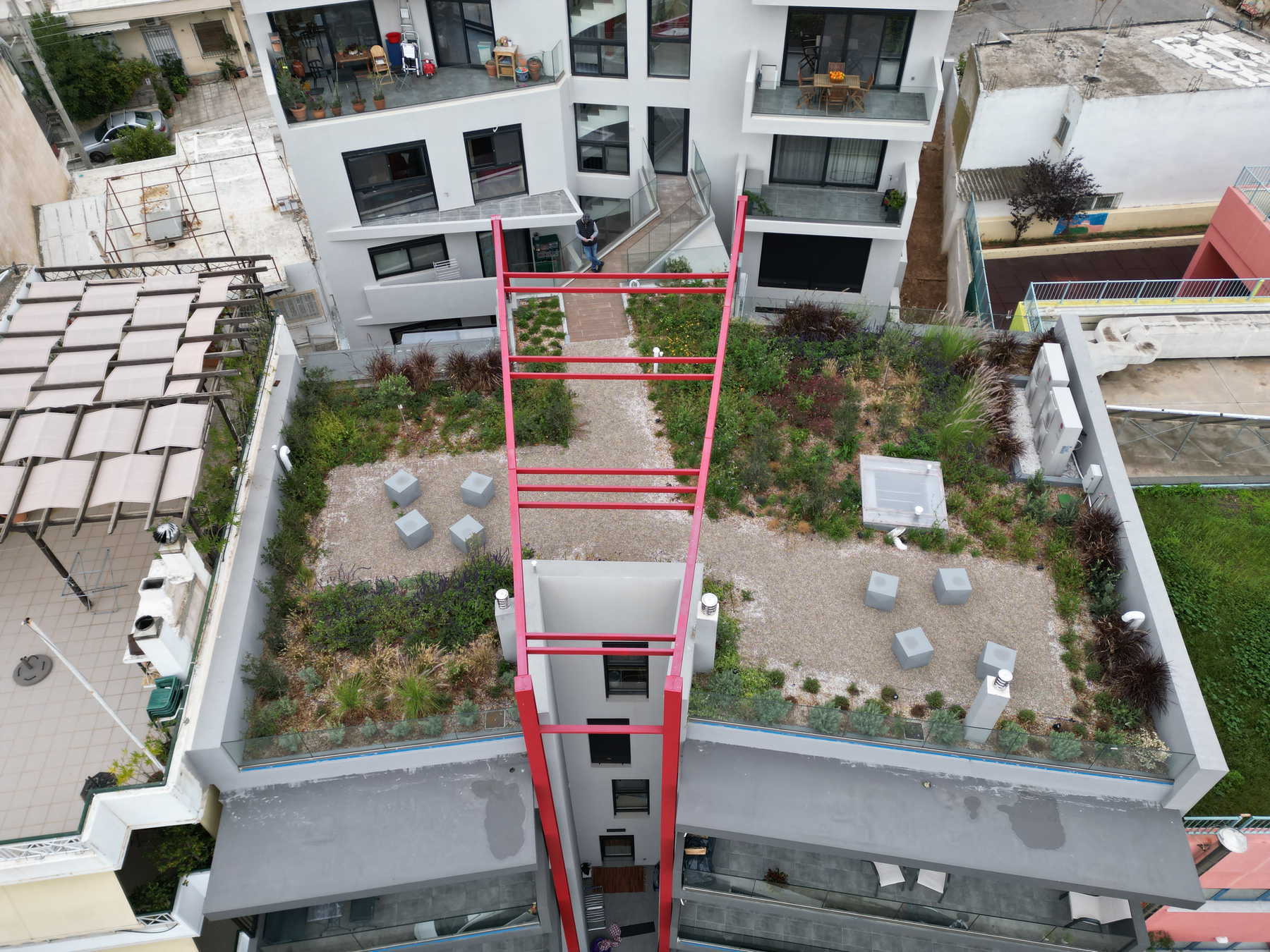
The first major benefit is thermal protection. A properly designed green roof reduces overheating of the roof surface, improves the performance of the building envelope and can reduce cooling demand during the summer. This is not a theoretical assumption; it is supported by both international literature and Greek applications.
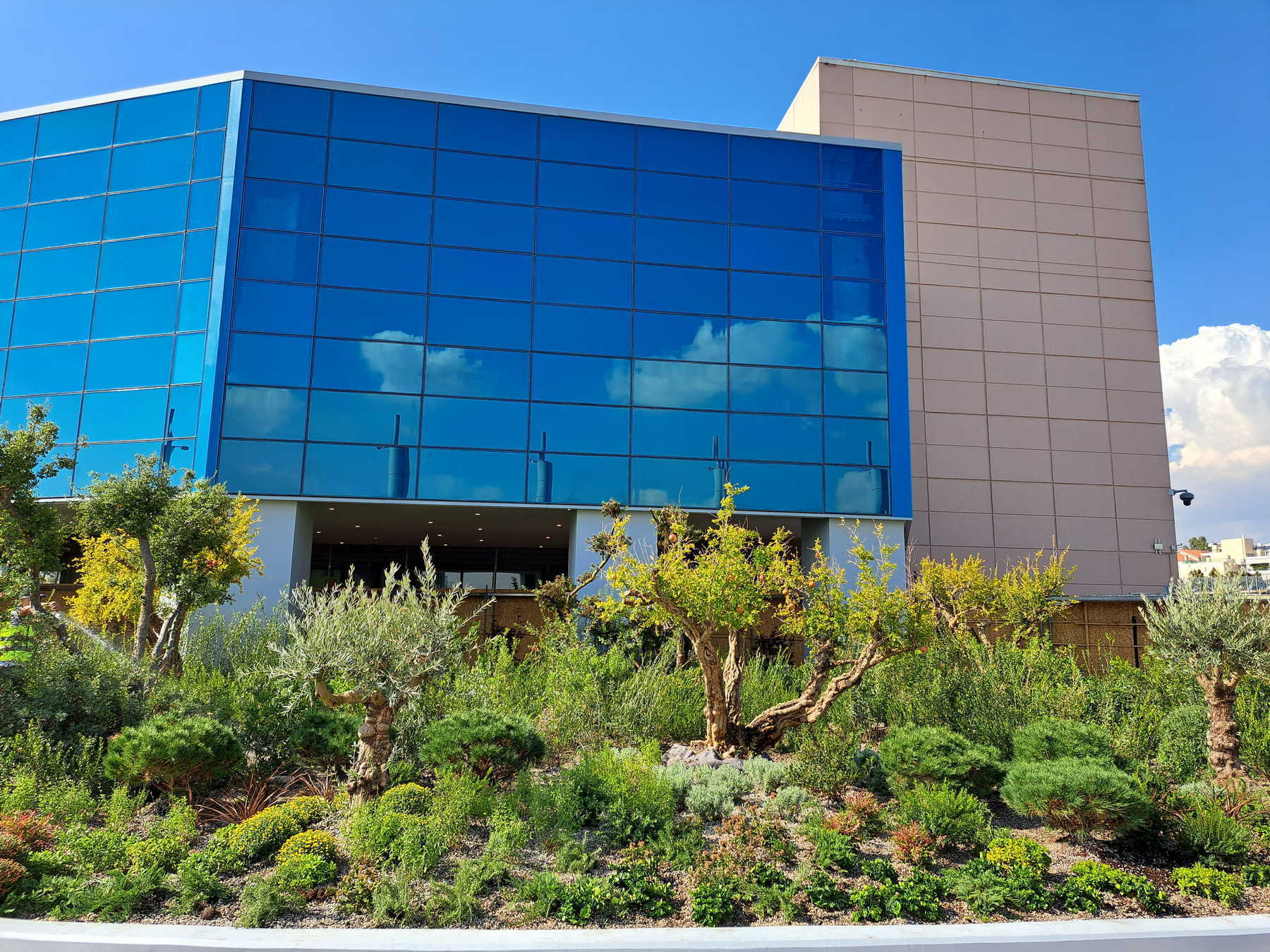
The second is microclimate improvement. Green roofs do not only affect the technical performance of the roof slab; they also change the experience of the space around them. In an intensive roof garden, the difference is felt not only in thermal terms but also in comfort, greenery, shade, visual quality and actual usability. That is one reason why green roofs are so valuable in hotels, commercial properties and residences. ECOVERTI’s own projects, such as Mitsis N’U Piraeus Port, show how a planted roof can function as an active hospitality environment rather than just a passive green layer.
The third is stormwater retention and runoff delay. International literature consistently shows that green roofs can retain and delay a significant share of rainfall, with actual performance depending on substrate depth, vegetation, antecedent moisture and season. In dense urban contexts, this has real value because every square metre that slows down runoff contributes to more stable water management.
The fourth is protection of waterproofing and roof assembly durability. When the system is properly designed, the layered build-up acts as a protective envelope against thermal shocks, ultraviolet radiation and daily exposure. Over time, this can contribute to more stable roof performance and better protection of the underlying construction.
Finally, there is the value of the roof as a usable space. Once a system moves into the intensive category, the conversation is no longer only environmental; it becomes architectural and commercial as well. This is evident in ECOVERTI’s own work, from the Mitsis N’U Piraeus Port roof garden bar to large-scale urban/commercial examples such as The Mall Athens, where greenery becomes part of the visitor experience and the spatial identity of the project.
Real problems and common failures in the Greek market
To make this article useful and serious, it is important to say clearly that green roofs are not a magic solution. The first major issue in the Greek market is the underestimation of the study phase. When a green roof is treated as a decorative landscape intervention rather than as a technical roof system, failures usually appear in drainage, load strategy, substrate choice, detailing and plant selection.
The second issue is the use of inappropriate growing media. Ordinary soil is not suitable for a green roof. It behaves differently in terms of weight, drainage, settlement and aeration. That is why the use of technical substrates—such as ERSM – Ecoverti Roof Substrate Mix in ECOVERTI projects—is not a detail but a core technical requirement.
The third issue is poor plant selection. The Greek and broader Mediterranean climate requires careful species selection based on drought, wind, exposure, substrate depth and irrigation strategy. Not all visually attractive plants are suitable for rooftop use. Research and review papers on Mediterranean green roofs repeatedly highlight the importance of species adapted to dry and thermally demanding conditions.
The fourth issue is water management and maintenance. In Greece, some roof failures have less to do with the concept of green roofs and more to do with the absence of a serious irrigation, nutrition and seasonal monitoring strategy. Mediterranean case studies clearly indicate that green roof success is closely linked to irrigation control and ongoing system management.
Greek legislation: what applies today?
The key legal reference for green roofs in Greece is Article 18 of Law 4067/2012 (New Building Regulation / NOK). This article provides that planted surfaces may be constructed on roofs, pitched roofs and outdoor spaces of new and legally existing buildings, provided that they do not conflict with more specific urban planning rules. It also states that such construction should not harm the aesthetics of the building, and that in pitched roofs the planted surface should follow the roof slope so that the form of the building is not altered.
The same article sets technical limits: the growing substrate and the specialised build-up layers must not exceed 40 cm above the maximum permitted building height, while vegetation must not exceed 3.00 m. These limits are important because they show that Greek legislation recognises planted roofs while placing them within a clear technical and planning framework.
For new buildings, a dedicated technical report must be submitted, describing the type of vegetation, the growing medium, the multi-layer roof system and the irrigation system. In practical terms, this means that a green roof must be technically documented as part of the broader building study.
For existing buildings, the framework is particularly practical: as a rule, no full building permit or small-scale works permit is required, subject to specific exceptions where protected areas, architecture council approvals or other formal approvals may apply. This is highly relevant for building owners and consultants who often assume that a planted roof is more difficult from a permitting standpoint than it actually is.
Why modern technology makes the difference
This is where the discussion moves from general principle to actual performance. A green roof does not succeed simply because plants were installed. It succeeds when the supporting technology is right. Optigrün officially describes itself as a leading and market-leading system provider for green roofs in Europe, with decades of experience, strong technical consulting and specialised systems for different project types. For the Greek market, this matters because it allows ECOVERTI to rely on tested system logic and adapt it to Greek climatic and project conditions.
This technological logic appears through specific families of systems already shown on ecoverti.com: solutions for lower structural reserves, economy systems for extensive applications, Nature Roof logic for broader plant diversity, Garden Roof for true roof garden conditions, retention roofs for runoff delay and sponge-city strategies, and more. That is important because it proves that the subject is not one generic “green roof,” but an entire ecosystem of technological choices.
The role of the substrate and ERSM
The growing medium is one of the most underestimated elements in many projects. In reality, it strongly influences weight, drainage, air-filled porosity, water retention, long-term stability and plant performance. ECOVERTI has correctly formalised its own terminology for ERSM – Ecoverti Roof Substrate Mix, precisely because rooftop growing media cannot be treated like common garden soil. Through the company’s project references and system logic, ERSM is presented as a technical material integrated into roof gardens and planted roof build-ups, rather than a generic filling medium.
This matters both technically and commercially. When a reader sees that ECOVERTI does not speak vaguely about “soil,” but instead uses a clearly defined roof substrate logic, it reinforces the message that the company approaches planted roofs as technical systems—not as decorative landscape add-ons.
Real ECOVERTI applications
The biggest difference between a generic explanatory article and a serious authority page is the presence of real projects. ECOVERTI now has a portfolio that demonstrates applied experience across different categories. At Mitsis N’U Piraeus Port, the planted roof was designed as a functioning roof garden bar, with low-maintenance logic, subsurface irrigation, fertigation and a build-up using elements such as RMS500, FKD25, FIL105 and ERSM. At The Mall Athens, the green roof functions within a high-visibility urban/commercial context, combining variable planting depths, Mediterranean planting logic, controlled irrigation and a full system-based approach. These are not just portfolio examples; they are proof that the theory can be translated into real projects.
Conclusion
Green roofs in Greece are neither a passing trend nor a niche solution for a few exceptional projects. They are a mature and documented tool of green infrastructure, with real thermal, environmental, architectural and commercial value. The legislation exists, the research base is substantial, the technologies are mature, and the Greek market now has built examples that show how properly designed planted roofs can perform in local conditions.
The critical question is not whether green roofs “work.” The critical question is who designs them, with what system, with what substrate, with what planting and with what technical responsibility. That is exactly where the difference lies between a superficial installation and a project that performs, lasts and adds real value to the building.
Frequently Asked Questions About Green Roofs
What is a green roof?
A green roof is a multi-layer technical system installed above a building’s waterproofing layer, allowing vegetation to grow on the roof. It is not simply planting on a slab; it includes drainage, filtration, growing medium and selected vegetation.
What is the difference between an extensive and an intensive green roof?
An extensive system has shallower substrate depth, lower weight and lower maintenance requirements. An intensive system—essentially a true roof garden—supports deeper planting, larger vegetation and full use of the space.
Are green roofs allowed in Greece?
Yes. The main framework is Article 18 of Law 4067/2012, which provides for planted surfaces on roofs, pitched roofs and outdoor spaces under specific planning and technical conditions.
Is a permit required for a green roof?
It depends on the case. For new buildings, a technical report is required within the broader permit documentation. For existing buildings, the law generally provides that no full building permit or small-scale works permit is required, subject to certain exceptions.
Why is Optigrün important in this field?
Optigrün officially presents itself as a leading and market-leading green roof system provider in Europe, with decades of experience and strong technical system development. For ECOVERTI, this matters because it supports project delivery with proven system logic and specialised product families.
Why is the substrate so important?
The substrate is critical because it affects weight, drainage, aeration, water retention and long-term plant performance. ECOVERTI uses ERSM – Ecoverti Roof Substrate Mix as part of its technical approach to planted roofs and roof gardens.
Does a green roof require maintenance?
Yes. Even extensive systems require periodic inspection of drainage, irrigation, nutrition and vegetation condition in order to ensure long-term performance.
Where can I see real applications in Greece?
ECOVERTI’s portfolio includes applications in hotels, commercial centres and residences, including Mitsis N’U Piraeus Port and large-scale urban/commercial references.
Legislative Appendix
- Main legal framework
The key Greek provision is Article 18 of Law 4067/2012 (NOK). It states that planted surfaces may be installed on roofs, pitched roofs and outdoor spaces, provided they do not conflict with more specific planning rules.
- Limits for substrate and vegetation
The same article provides that the growing substrate and specialised build-up layers must not exceed 40 cm above the maximum permitted building height, and that vegetation must not exceed 3.00 m.
- What is required for new buildings?
For new buildings, a dedicated technical report must be submitted describing the vegetation, the growing medium, the roof build-up system and the irrigation system.
- What applies to existing buildings?
For existing buildings, the law generally states that no building permit or small-scale works permit is required, subject to specific exceptions relating to protected zones or required approvals.
- Practical conclusion
The legislation facilitates green roof construction, but it does not replace structural evaluation, technical detailing and planting design. A project may be legally possible and still be technically wrong if not properly studied.