
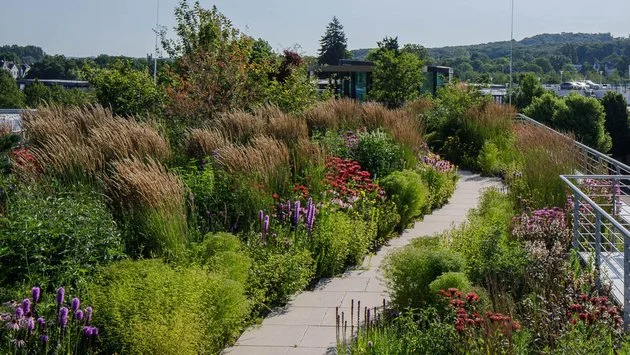
Green roofs are no longer a niche or purely aesthetic option. In contemporary architecture and modern building design, they function as multi-layered green infrastructure that affects thermal performance, waterproofing protection, stormwater management, biodiversity, urban microclimate and, ultimately, the long-term value of the property. That is why the market is not simply looking for “green roof materials,” but for complete systems that have proven their performance in real projects. This is exactly the level at which OptiGreen has established its reputation in the European market.
OptiGreen presents itself as a market-leading provider of green roof systems in Europe, and that position is backed by substance rather than branding alone. On its official company pages, the group states that, together with around 140 partner companies, it greens more than 5 million square metres of roof area worldwide every year, supported by around 160 employees. It also states that in 2023 alone it contributed to approximately 5 million square metres of extensive and intensive greening across almost 9,000 projects. These figures are not just impressive; they indicate continuity, scalability and deep accumulated technical knowledge.
Its historical trajectory helps explain this market weight. Optigrün traces its roots back to the early 1970s, noting that the licence for the German market was obtained in 1972. In its company history, it explains that the first years were marked by intensive technical groundwork, at a time when key issues such as root resistance and water drainage had not yet been clarified to the level they are today. It also highlights the first FLL green roof guideline in 1982 and the development of blowable substrates as major milestones. In other words, OptiGreen did not simply enter a mature sector; it helped shape it.
Why OptiGreen carries real weight in the green roof market
OptiGreen’s relevance comes from the fact that it does not treat a green roof as a collection of products, but as a complete technical system. In a properly designed green roof, each layer serves a clear purpose: protecting the waterproofing, ensuring reliable drainage, retaining water, filtering fine particles, aerating the root zone and supporting stable, long-term plant development. This system-based logic is crucial, because performance depends not on one individual product, but on the way the full build-up works together.
That philosophy is reflected in the breadth of the company’s system portfolio. OptiGreen does not limit itself to one standard extensive build-up; it offers dedicated solutions for economy roof, lightweight roof, nature roof, retention roof, pitched roof, solar green roof, garden roof, landscape roof and public roof. The existence of this full range means the company can support everything from lightweight applications for limited structural reserves to accessible, intensive and multifunctional roofscapes with demanding performance requirements.
The technical data published for these systems reinforces that point. The lightweight roof starts from 55 kg/m² and 60 mm build-up depth; the nature roof starts from 95 kg/m² and 100 mm, with annual water retention of 50–70%; the garden roof starts from 320 kg/m² and 260 mm; and the landscape roof reaches 600 kg/m² from 420 mm, with planting options that include perennials, woody plants and trees. The public roof starts from 400 kg/m² and 180 mm, showing that accessible and high-use roof areas are treated as a serious technical category in their own right. This means OptiGreen is not just offering “green on a roof,” but supporting complex, functional and architecturally demanding roof environments.
The company’s market significance is also reinforced by its consulting-led identity. On its official homepage, OptiGreen describes itself as an owner-managed family business with a strong service orientation and a high level of consulting, noting that projects are planned individually according to the current state of the art and in line with applicable standards and guidelines. That matters greatly in markets such as Greece, where projects can vary significantly in use, structural capacity, maintenance demands, planting depth and climatic exposure.
Innovation that does not remain theoretical
One of the clearest reasons OptiGreen retains such a strong market position is that it does not stop at repeating a conventional green roof package. It continues to develop solutions that connect green roofs with today’s biggest urban priorities: climate adaptation, resilience to extreme rainfall, resource efficiency, microclimate improvement and the integration of complementary technologies such as photovoltaics. On its company pages, OptiGreen explicitly refers to research and development and highlights examples such as Smart Flow Control and the use of Recyclatt to reduce CO₂ emissions.
Smart Flow Control is perhaps the clearest example of this approach. OptiGreen presents it as an intelligent, automated rainwater management solution that uses weather forecasting and system capacity to optimise runoff control and storage potential on the roof. In practical terms, the roof stops being a passive green layer and becomes an active stormwater management component. The significance of this approach was recognised externally as well: Smart Flow Control received the Green Infrastructure Goes Business Award 2024.
Similarly, the solar green roof approach shows how the company combines green roof infrastructure with renewable energy. OptiGreen’s system pages explain that its load-bearing solar mounts can be combined with various system build-ups and allow multifunctional roof use without roof penetration. This reflects a broader direction in which green roofs are no longer treated as isolated systems, but as active infrastructure capable of combining ecology, urban cooling, water management and energy generation.
In the retention roof segment, the company makes the connection to the “sponge city” concept even clearer. Its official retention roof pages describe green roofs and intelligent rainwater management as working together effectively and sustainably, specifically to improve the microclimate and comply with runoff restrictions or delayed discharge requirements. That positioning is especially relevant in an era of more intense rainfall events and growing pressure on urban drainage networks.
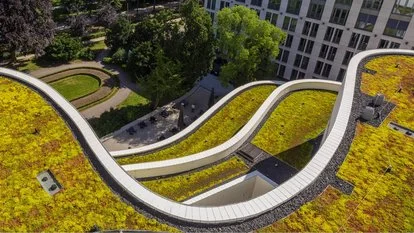
OptiGreen as know-how, not just as product
The real difference between a conventional supplier and a mature system provider lies in the technical knowledge that accompanies the products. OptiGreen has built a strong reputation precisely because it does not limit itself to supplying systems. It also transfers expertise to the market through planning resources, technical guidance, system tools and education-oriented support for professionals. Its homepage and system resources include BIM objects, installation guidance, brochures, checklists, specialist topics, technical data and project references, all of which point to an ecosystem built around specification and successful implementation, not just sales.
This educational dimension is not theoretical. On the Greek Optigrün page, the framework of support is described in terms of advice, support, supervision, training and know-how, with guidance for architects, planners and specialised companies in the early stages of projects, including tender preparation and technical calculations related to wind uplift, water retention and solar design. That language makes it clear that the brand is positioned not merely as a manufacturer, but as a technical partner in real project development.
This logic is particularly important in the Greek market. In warm, highly urbanised environments such as those found across Greece, the success of a green roof depends on much more than visual greening. It depends on the quality of drainage, moisture balance, waterproofing protection, root-zone aeration, planting adaptation, maintenance planning and compatibility with the specific use of the space. OptiGreen matters because it approaches these issues with structured technical logic rather than with generic commercial answers.
Our presence in Greece
In Greece, this relationship is expressed through us, ECOVERTI. On the Greek Optigrün website, ECOVERTI is presented as the local partner, while on our own roof garden service page we state clearly that we are the official representative of Optigreen GmbH in Greece and that we operate as Optigreen technical consultants for the Greek market. The same Greek Optigrün page also describes a support framework based on advice, supervision, training and know-how, which is fully consistent with the role we have developed in the local market.
For us, this collaboration is not simply a commercial association with a major European system provider. It is a technical responsibility. We approach every roof garden and every green roof build-up as specialised green infrastructure with demanding performance and durability requirements. We provide technical guidance to architects, civil engineers, planners and contractors so that the correct system can be determined according to the intended use of the space, loads and structural capacity, planting depth, microclimate and maintenance requirements. Our own service page describes this role explicitly.
Our knowledge of Optigreen systems allows us to undertake the full technical path of a project: green roof studies, system build-up specification, selection of protection and drainage components, choice of growing media, planting design, construction, supervision, maintenance training and after-sales technical support. We do not limit our role to product supply. We participate in defining the technical direction of the project from concept to long-term performance.
Why this collaboration matters for architects, contractors and private clients in Greece
For architecture offices, the value of this collaboration lies in the fact that a green roof is not treated merely as a design image or a visual sustainability gesture. It is treated as a technical system that must be integrated correctly into the structure, the intended use and the architectural concept of the project. We can support the process from an early stage by helping identify the right system, align it with architectural requirements and translate OptiGreen solutions into real construction terms.
For contractors and project delivery teams, the key value is risk reduction. A green roof is a technically demanding construction, and failures can be costly: drainage problems, insufficient waterproofing protection, poor root-zone aeration, incorrect system build-up selection or unsuitable substrate choices may all create serious issues after completion. Technical guidance from a company with deep knowledge of Optigreen systems adds security at the stages of study, budgeting, implementation and maintenance.
For private clients, developers and investors, this collaboration has value because it turns a desirable concept into a mature investment. The right system affects not only the visual result, but also durability, functionality, maintenance, water use, energy performance and, ultimately, the commercial and environmental value of the property. A well-designed roof garden can become a genuinely useful living or hospitality space, a sustainability asset for the building and a clear competitive advantage in the market.
Significant projects in Greece using OptiGreen systems
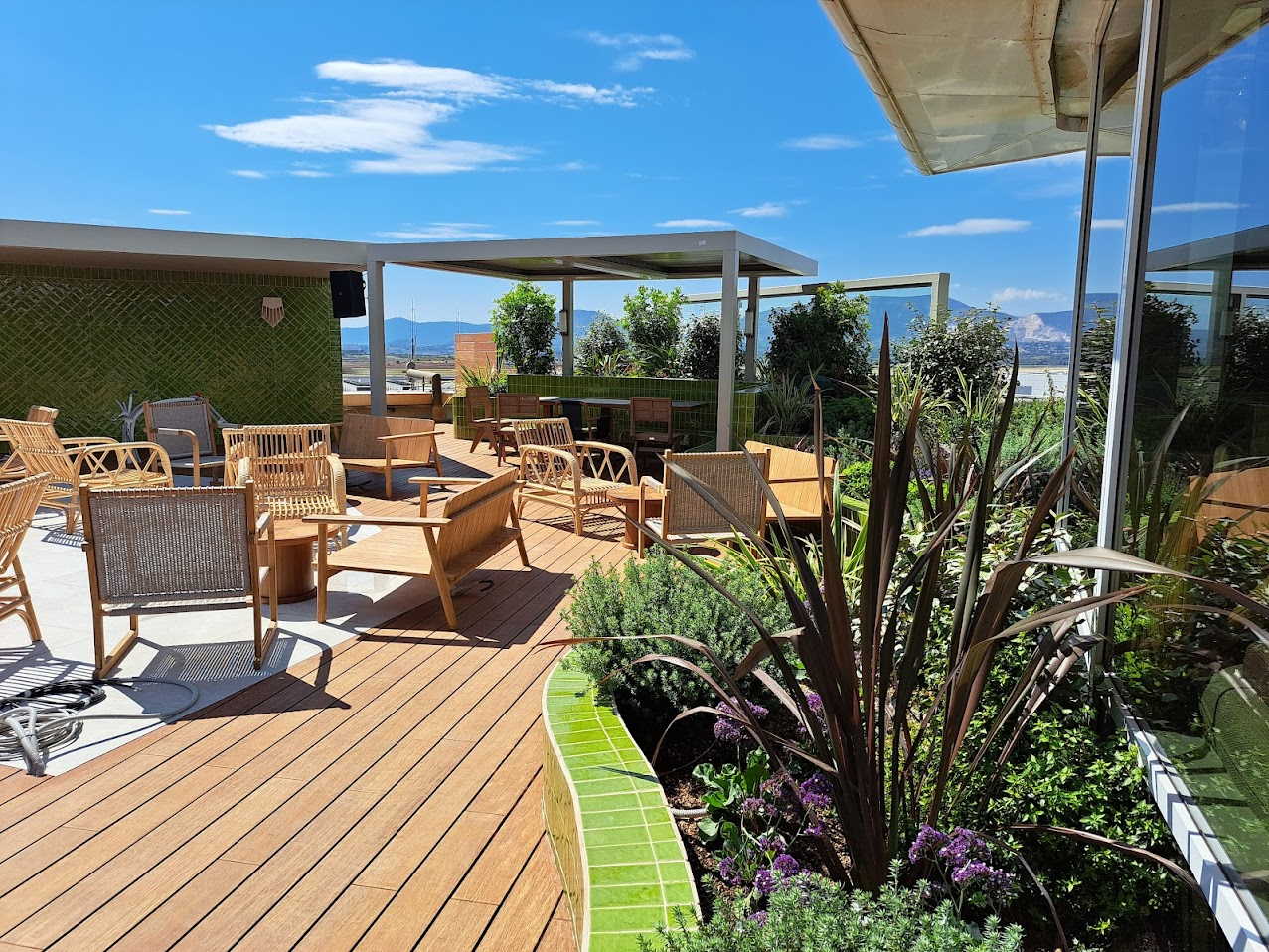
The value of this collaboration is ultimately demonstrated through built work. At Mitsis N’U Piraeus Port Hotel, we delivered a roof garden project designed to create a functional, high-aesthetic rooftop bar. According to the published project page, the system included root barrier protection, RMS500 water retention and protection fabric, FKD25 drainage, FIL105 filter sheet by OptiGreen and ERSM – Ecoverti Roof Substrate Mix, with a strong focus on low maintenance, water efficiency and long-term system sustainability in the dense urban environment of the Port of Piraeus.
At The Mall Athens, on Level 2 at the main entrance, we implemented a green roof / urban green space project with variable planting depths of approximately 17–30 cm. The published technical description states that the build-up included OptiGreen RMS500, OptiGreen FKD40, FIL150 by OptiGreen and ERSM – Ecoverti Roof Substrate Mix, as well as a Wi-Fi connected underground irrigation system for remote monitoring and control. This is a strong example of a project that combines technical accuracy, durability and visual quality in a high-traffic and highly exposed urban setting.
Our broader project portfolio also includes Sofitel Athens among ECOVERTI’s distinguished works, alongside The Mall Athens, demonstrating experience in high-profile hospitality and commercial environments where the technical performance of the green roof must match demanding architectural and operational expectations.
Taken together, these projects show that OptiGreen systems in Greece are not being used only in theoretical studies or small-scale applications. They are being applied in demanding hospitality environments, major commercial assets and complex urban conditions where technical precision, durability and aesthetic performance must work together.
Conclusion
OptiGreen is not simply another brand in the green roof sector. It is one of the organisations that helped move the green roof from a visual concept to a serious technical infrastructure category. With more than 50 years of experience, around 160 employees, around 140 partner companies and more than 5 million square metres of greened roof area annually, along with continued system development for retention, solar-integrated and multifunctional roof applications, it stands as a clear reference point in the European market.
For us at ECOVERTI, this collaboration means something far more substantial than simple commercial representation. It means we can bring to the Greek market not only OptiGreen systems themselves, but also the correct way to study them, specify them and build them. As the official representative of Optigreen GmbH in Greece and as technical consultants for the Greek market, we act as the point where international know-how is translated into real projects, technical guidance and implementation confidence. That is what ultimately gives this partnership real value for serious, durable and high-level green roof projects in Greece.